Davao keeps growing. New subdivisions in Catalunan Grande, Cabantian and Mintal, condos near Lanang and Bajada, and townhouse projects all over the city. Behind every project is the same daily challenge: knowing which lots are still available, who has paid, who is late and how much each agent has earned.
This guide is for small and mid-sized developers, brokers and contractors in Davao City and the Davao Region. It explains what real estate software should track, what to ask before you buy, and how to move from spreadsheets without losing buyer records.
Key takeaways
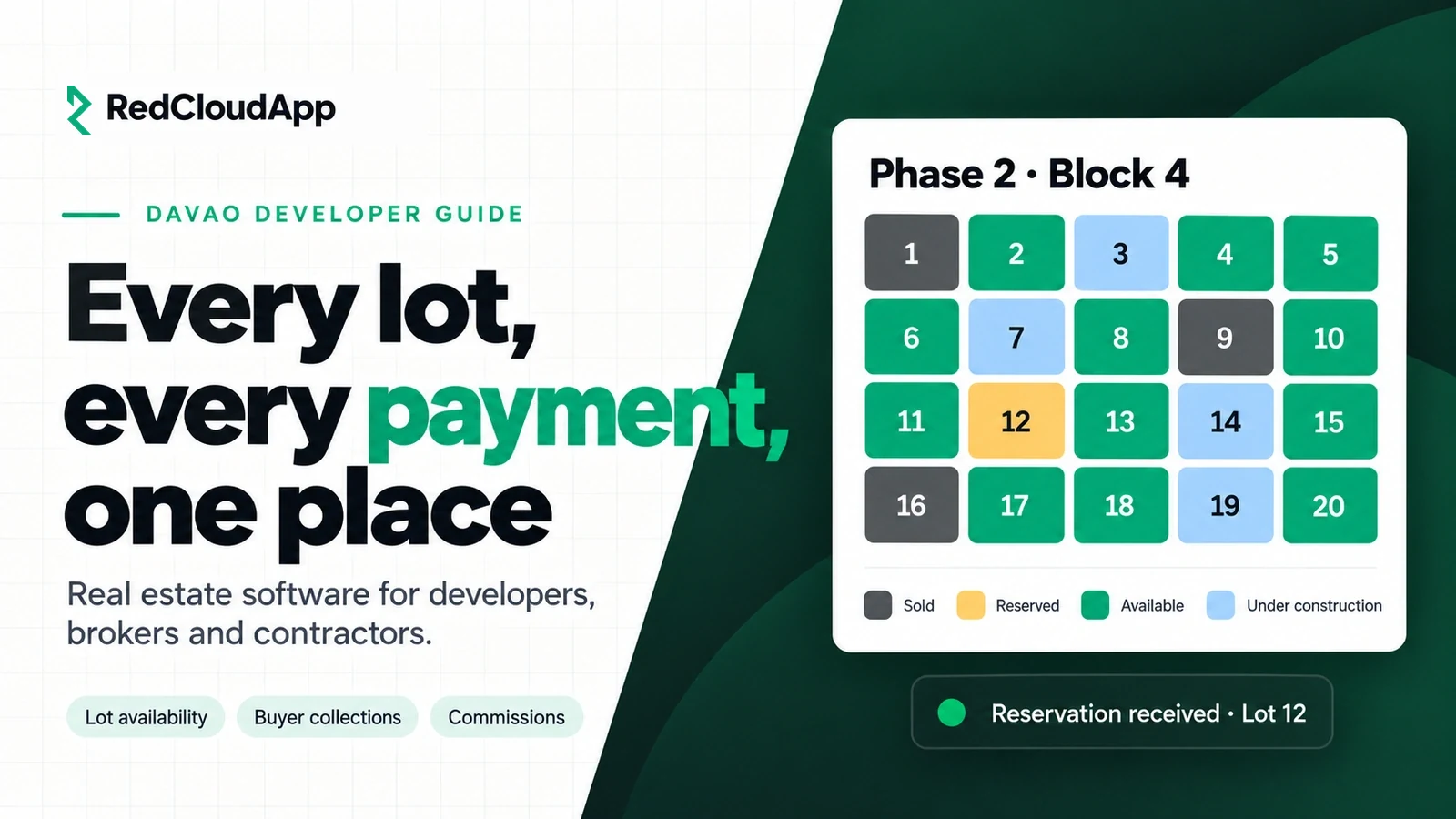
- Keep one live list of lots and units: available, reserved, sold or under construction.
- Track every buyer payment against a clear schedule, from reservation to full payment.
- Calculate agent commissions from actual collections, not from memory.
- Keep construction costs and progress per phase or block.
- Make sure your records can show exactly what each installment buyer has paid.
Signs your spreadsheets are holding you back
- Two agents reserve the same lot because the list was not updated.
- Buyers ask for a statement of account and it takes days to prepare.
- Late payments are noticed only at month end.
- Agents question their commission computation.
- Construction costs are in a different file from sales.
- Only one person really understands the master spreadsheet.
What real estate software should track
| Area | What it tracks | Why it matters |
|---|---|---|
| Lots and units | Status of every lot or unit per phase and block | No double reservations |
| Reservations | Reservation fee, date and expiry | Expired reservations go back on sale on time |
| Buyer accounts | Equity, amortization, payments and balance | Fast, accurate statements of account |
| Collections | Due dates, late payments and penalties | You follow up before accounts fall behind |
| Commissions | Agent share based on payments received | Fewer disputes with brokers and agents |
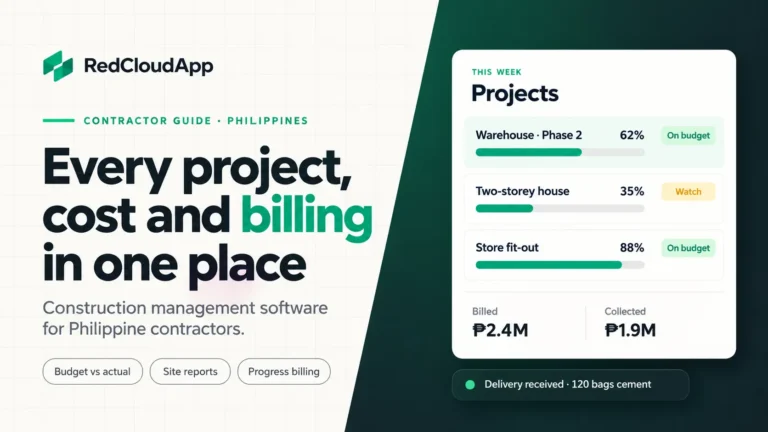
| Construction | Budget, spending and progress per phase | You see if a project is on budget |
5 things to check before you choose a system
1. A lot map or unit list your team can read quickly
Your sales team should see available lots in seconds, ideally on a phone during a site tripping. Ask for a view by phase and block, with clear colors for each status.
2. Payment schedules that match your terms
Every developer has its own mix: reservation fee, spot down payment, equity spread over months, then bank or Pag-IBIG financing or in-house amortization. Ask the seller to set up one of your real payment terms in the demo.
3. Clear records for installment buyers
If you sell on installment, the Maceda Law (Republic Act No. 6552) gives buyers certain rights, such as grace periods and refunds when a sale is cancelled. Your system should show exactly what each buyer has paid and when. Confirm your obligations with your lawyer.
4. Commissions computed from collections
Most commission disputes happen because the computation is not visible. Ask how the system splits commissions between brokers and agents, and how it releases them as payments come in.
5. Construction costs in the same place as sales
When sales and construction costs live in separate files, you only see the full picture at year end. A system that shows both per phase helps you decide when to open the next phase.
How to move from spreadsheets
- List every lot or unit with its current status. Check it against your DHSUD-approved plan.
- Enter active buyers and their payment terms. Start with accounts that are still paying.
- Match balances with your accounting. Fix differences before going live.
- Add agents and commission rules.
- Run both for one month. Compare statements before you retire the spreadsheet.
Questions to ask in every demo
- Can you set up one of my real payment terms?
- How fast can I print a buyer’s statement of account?
- How do I see all late accounts today?
- How are commissions computed and released?
- Can sales agents see availability on a phone?
- Who can change prices or payment terms, and is there a history?
- Can I export all my data?
Where RedCloudApp fits
RedCloudApp builds real estate and construction software for developers and contractors in Davao and across the Philippines. It covers lot and unit inventory, reservations, buyer collections, commissions, construction costing and site progress. Each system is set up around your projects and payment terms, on a custom plan. We start with a free meeting, show you a live demo and send a written proposal.

Frequently asked questions
What is the best software for a small real estate developer?
One that tracks your lots, buyer payments and commissions in one place, and fits your payment terms. Ask any seller to set up one of your real projects in the demo before you decide.
Can the system handle Pag-IBIG and bank financing?
It should track the buyer’s equity and the expected loan release, and mark the account when financing is approved. Ask to see how your exact financing steps are recorded.
How does the Maceda Law affect my records?
The Maceda Law (RA 6552) gives installment buyers rights such as grace periods and refunds on cancellation, depending on how much they have paid. You need accurate payment records for every buyer. Confirm the details with your lawyer.
Can contractors use it without selling units?
Yes. Contractors can use the construction side: budgets, purchase orders, spending and progress per project or phase.
How much does real estate software cost?
It depends on the number of projects, users and the features you need. We work on a custom plan. After a free meeting, we send a written proposal with a clear price.